
The highbrow rom-com
And why literary snobbery ages badly

One of my character faults — a fault common to many snobs — is that if a lot of people are reading and writing about a particular book, I tend to lose interest in reading or writing about it myself (this is the main reason I have never read Stoner). I used to find the idea of reading Hegel appealing; now that all kinds of things and people are advertising themselves as “Hegelian,” the appeal is much diminished.1 The negative consequence of this attitude is that I miss out on some very good books. The positive side: I like to think I have an eye for the under-read and under-discussed. Browsing used bookstores, especially if they’re indifferently-curated and have lots of junk, is a good way to discover classics that other people aren’t reading. On the other hand, often I think I’ve found a hidden gem only to discover it’s been neglected for very good reasons.
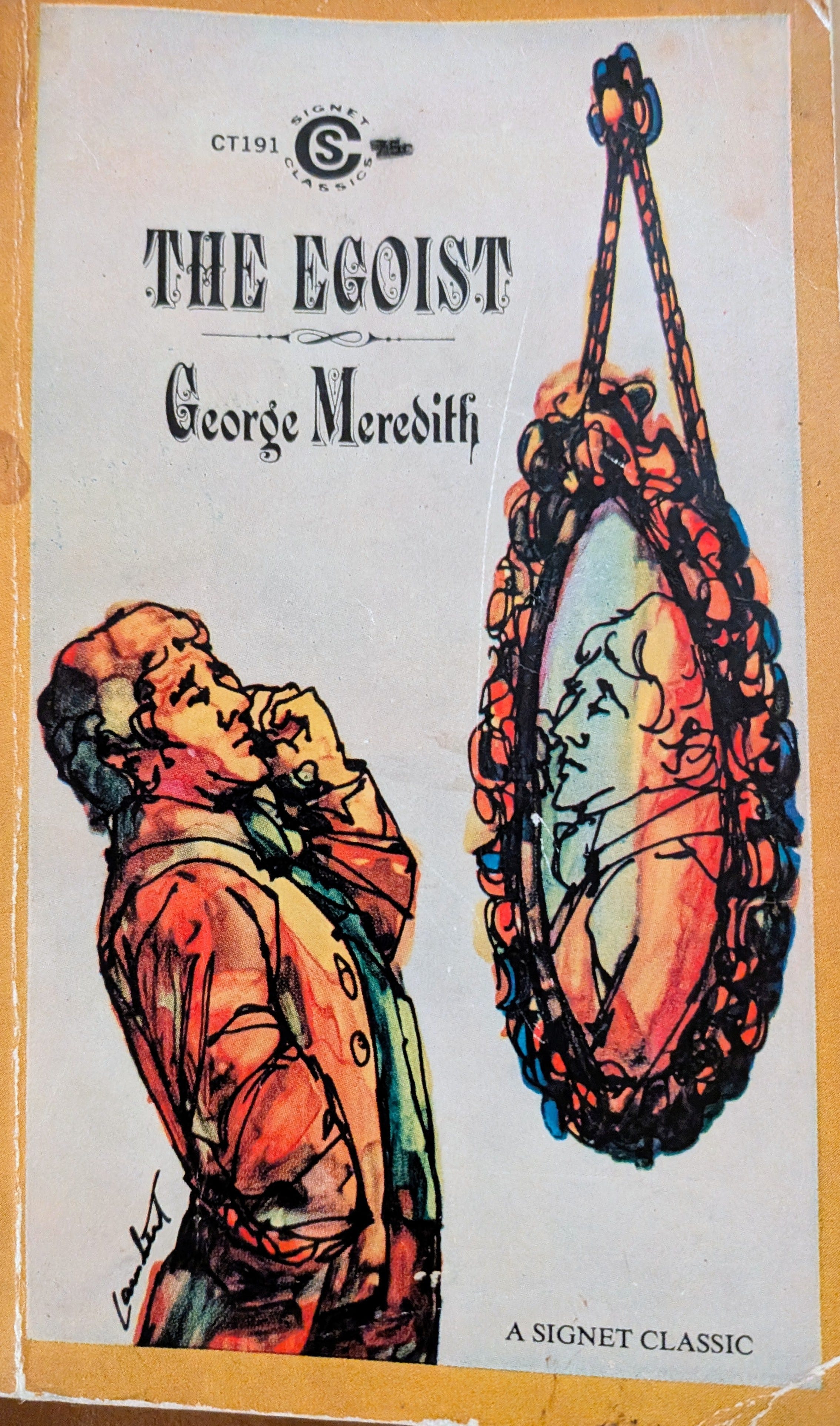
George Meredith’s 1879 comic novel The Egoist, which I purchased at a used bookstore in Victoria, doesn’t quite fit into any of these categories. It’s been able to maintain a reputation as a classic, with multiple scholarly editions in print, but doesn’t appear to be widely read, certainly not in comparison with the work of Meredith’s contemporaries like George Eliot and Thomas Hardy. There are some obvious reasons for this which I’ll get into later, but it’s also a fascinating read.
The novel’s titular Egoist is Sir Willoughby Patterne, a rich and handsome English gentleman who has arranged his life so as to be always surrounded by admirers and supplicants. His childhood friend, Laetitia, adores him from a distance, and though he has no intention of marrying her, he periodically gives her just enough hope to keep her in suspense. He is comfortable sabotaging the careers of his friends and dependents if it means keeping them at hand to entertain him, and he naturally expects to enjoy complete dominion over his future wife.
What happens to Willoughby is kind of like Pride and Prejudice in reverse: the story begins when he becomes engaged to a beautiful young woman named Clara. Initially dazzled by his wealth and style, Clara likes him less and less as she gets to know him better, suspecting and then confirming the terrifying depth of his self-absorption. When she asks to be released from their engagement, his pride forbids him from agreeing. He’s happy at first to chalk her distress up to feminine fickleness and frivolity, but when it becomes clear that she’s serious, he resorts to manipulation and blackmail. The bulk of the novel concerns Clara’s increasingly desperate attempts to extricate herself from the engagement to Willoughby and win back her freedom.
The novel is notable for its psychological insight and its sympathy towards women. “Are they not of a nature warriors, like men — men’s mates to bear them heroes instead of puppets?” he writes of women. “But the devouring male Egoist prefers them as inanimate overwrought polished pure-metal precious vessels, fresh from the hands of the artificer, for him to walk away with hugging, call all his own, drink of, and fill and drink of, and forget that he stole them.” In many passages Meredith’s narrator rebuts the idea that women are frivolous and less intelligent than men, and rails against the expectation that they remain passive, sheltered, and ignorant.
One of the best scenes is between Willoughby and Clara’s father. Willoughby, finding that Clara is trying to flee his estate and has petitioned her father to leave the next morning, invites the other man to privately sample a fine wine from his cellar. As the two drink together, they indulge in a little male bonding, telling each other that women can’t understand this pleasure the way they do: “Ladies are creation’s glory, but they are anticlimax following a wine of a century old… Can they, though they are dear to us, light up candelabras in the brain, to illuminate all history and solve the secret of the destiny of man? They cannot; they cannot sympathize with them that can.” The next morning, thoroughly won over by Willoughby and the promise of more wine, Clara’s father refuses her request to leave.
Though Sir Willoughby is his primary object of satirical derision, Meredith is careful to note that all the characters are egoists in their own way. Clara, in wanting to break her engagement, is placing her own happiness over that of her father, her fiancé, and others who would benefit from the marriage. She grapples seriously with what she sees as the hypocrisy of condemning Willoughby’s egoism while acting egoistically herself. Her initial attempts to frame her desertion as self-sacrificing — doesn’t Willoughby deserve to be with someone who admires him the way he requires? — fail utterly. And the novel is fairly explicit in making its point that Clara can only win back her freedom and dignity by the honest exercise of her own egoistic free will.
But The Egoist has its problems. Despite belonging to one of the most popular and accessible of all literary genres — the romantic comedy — it is anything but an easy read. Its opening chapter is a mini-treatise on the nature of comedy. The prose style is self-consciously high-flown and florid, with long and complex sentence structures and heavily-labored metaphors. The vocabulary is expansive, frequently crossing the line into recondite. And the text is so heavy with allusions to mythology, classical literature, Shakespeare, and others that I often wished I had an annotated scholarly edition rather than a mass market Signet Classic paperback. A few times I wondered if Meredith, who was reportedly ashamed of his working-class background, was deploying this erudition to compensate for having written a rom-com rather than serious social novels like his contemporaries.
The most striking thing about The Egoist is how at odds it feels with its time. In its self-conscious classicism, to me it often reads much more like an 18th century novel than the work of a contemporary of Thomas Hardy and Mark Twain. And it’s not a style that has aged particularly well. The back of my Signet Classic paperback has a quote from the critic William Ernest Henley, extolling the novel: “Meredith is a companion for Balzac and Richardson, an intimate for Fielding and Cervantes… The Egoist is a piece of imaginative work as solid and rich as any that the century has seen.” I doubt anyone today thinks of Meredith when they think of the great novelists of 19th century England, or puts him on par with Balzac. Seamus Perry, writing about Meredith for the London Review of Books, notes the decline in Meredith’s reputation: “no one can regard him as a significant thinker now – almost all of his work is long out of print – but for a few decades at the end of the 19th century and the start of the 20th he was the cutting edge, a highbrow’s highbrow, and he evidently entertained philosophical ambitions of serious amplitude.”
The “highbrow” designation is an interesting one when it comes to guessing which authors will remain popular in the decades and centuries following their work. The “popular” vs “highbrow” distinction by itself isn’t very useful; among both categories there are works that remain beloved and works that have been forgotten. But I think there’s a quirk about the nature of the “highbrow” that puts those works in particular danger — and it’s related to the fault I admitted above, my not wanting to read any book that gets too buzzy. In every era, there are people who revere the works of the past (especially if they’re difficult, or require some education to appreciate) as standard-setting, insisting that the art of their own time is hopelessly inferior.2 If artists respond to this rhetoric by aspirationally imitating the styles of bygone eras, they may become legible as “highbrow” in their own time. But such works often age poorly. Once they’re no longer set in relief against a present day that’s assumed to be “fallen” — once they’re on equal footing with the best of their contemporaries, with everyone’s work receding into a cloudy past — they no longer read as highbrow and become, instead, simply old-fashioned. Their pretensions read as inauthentic, the affectations are merely oddities. They only get read by scholars, or else picked up from used bookstores and read by casual literary egoists like me.
The Egoist is still a great novel, and the parts of it that have aged the best are its most forward-looking elements: its critique of bourgeois conventions and gender roles, the rich and subtle interiority of its characters, its humor, its unwillingness to be sentimental. It probably would be more beloved by modern readers at half the length and half the mythology, but if you’re up for it, it’s a very rewarding read.
I’m aware that it’s extremely annoying to assume this posture when I have read zero works by Hegel.
Meredith, in a lecture at the London Institution, expressed the opinion that British comedy had been in decline since the days of Congreve, and in the novels of his own century he found only Jane Austen truly comic, and only in scattered places. He did not like Oscar Wilde. (according the afterward to The Egoist by Angus Wilson)
Oh neat — I do think that the psychological insight is keen enough to overcome the overwrought style. Funny how much distance there is between his style and, say, Henry James (who also wrote in a "difficult" style that somehow doesn't feel like a pastiche of something else). I saw it mentioned somewhere that Meredith was very interested in Darwin and Darwinist views of social relations. One of the reasons I wished I were reading a scholarly edition, since I couldn't quite put together how that came through in the text.
As it happens, I've lately been reading Hegel's Philosophy of History. But it's for a project I'm working on. Which doesn't rule out that Substack trends might have played a role: why read it now rather than later?
I've read one Meredith novel, The Ordeal of Richard Feverel, which is probably his most famous. At the used bookstore where I bought it, the owner said: "You don't see a lot of people reading Meredith nowadays."
But I did read it, and I was glad I did. Admittedly it has the same faults you identified above - kind of a sludgy, over-intellectualized style. But it stood out by its high theoretical and idea-based content. It reads more like a German or Russian novel than an English one. There's also a startling amount of sexual content for a Victorian novel (though heavily psychologized). Meredith seems to be pointing forward to modernist psychological writing while using an archaic learned style, which creates an interesting effect.